Context
At will bank I led design for commissioned products: insurance, mobile top-up and capitalization. Card insurance with Disney+ had just proved that our customers responded to the right offer. But it was still an old product with a new hook.
The goal was not just to launch a product, but to build a data ecosystem for future insurance offers. To get there, I organized the team's discovery in levels.
What the research said
We ran in-depth interviews with simple account customers, a strategic focus for the bank, to map the pains of people with no insurance. For customers who already had insurance, I built a JTBD bot with n8n and Figma Make that asked why they kept it. A second round of interviews went after their anxieties and the unexpected.
- The pain that breaks the budget isn't death. It's health (medicine, exams, treatments) and losing income when you can't work.
- People "hire" insurance for financial stability first, and to take care of their family second.
- The biggest fear is paying for years and not being covered when it matters, or getting lost in red tape.
- Insurance felt expensive and unnecessary. A fair price was somewhere between R$5 and R$100 a month.
- The real competitor was inertia: trusting that nothing bad will happen, until it does.
- For self-employed customers, the phone is a work tool. Losing it means losing income.
What I did
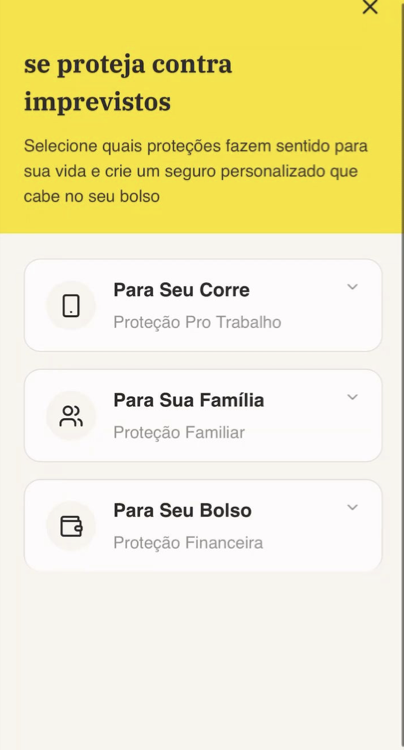
I used the same no-code fake door logic from the Disney+ test. A minicard on the Home screen led to a Figma Make prototype where people built their own insurance, choosing coverages one by one. Clarity recorded the sessions and Supabase stored every pick, price and drop-off.
I grouped eleven coverages by what they protect, and wrote the copy in our customers' own language: for your hustle (broken or stolen phone, motorcycle, work tools), for your family (family protection, funeral support, pharmacy allowance, health discounts, telemedicine) and for your pocket (daily pay on sick leave, scam protection).
25,195 people opened the prototype from Home, and 6,893 went through the whole journey. The URL told me which of four groups each one came from: simple or full account, and whether they had clicked an insurance offer before.
What people picked
Behavior confirmed the interviews. People went straight for income and scams, well ahead of the phone or the motorcycle.
The bundles people built
117 people combined daily pay on sick leave with scam protection. 42 built a family set, and 35 a work set with phone, motorcycle and tools.
Family, again
Pharmacy allowance and health discounts let people add dependents. 156 did, mostly spouses (162) and children (49). Insurance stops being an invisible expense when the whole family can use it.
Who signed up
Simple account customers who had already clicked an insurance offer were the clear early adopters: 14.6% signed up, and they built more expensive insurance, R$35.56 a month on average. Full account customers dropped off more than 98% of the time and built cheaper insurance, around R$26.